|
The Center on Philanthropy at The Beautiful Foundation involves researchers from various fields—including social welfare, tax, accounting, law, sociology, business administration, economics, and public administration—to conduct “Featured Research” on various themes of Philanthropy. This research aims to improve social perceptions of giving, enhance the fundraising capabilities of nonprofit organizations, and produce effective policies. On December 4th and 5th, a two-day online event was held via ZOOM to share four major research projects.
|
1. Rationalizing Real Estate Donation Systems for Public Interest Corporations (Won HUR, Professor at Department of Taxation and Accounting, The Cyber University of Korea)
This research analyzes problems in current tax laws and systems regarding real estate donations and proposes improvements to ensure stable funding for public interest corporations.
• Key Problems: Tax reduction benefits are limited to specific corporations, mandatory use regulations for donated assets (within 3 years), legal claims for elective shares (forced heirship), and complex procedures for disposing of basic assets.
• Proposed Improvements: Expanding the scope of tax reduction targets, broadening exceptions for mandatory use violations, introducing a system for the prior waiver of elective shares and inheritance tax reductions, and easing regulations on the operation and disposal of basic assets.
Q&A Highlights:
• Statistics: There are currently no specific statistics on the total proportion of real estate in domestic donations.
• Accessibility: The proposed improvements aim to move away from individual legal bases for tax benefits toward a standardized system. This is intended to benefit not just large organizations but also small-scale public interest corporations and institutions currently excluded from public disclosure.
• Preventing Misuse: While the current research focused on removing barriers to in-kind donations, further research is needed to address how to prevent the negative use of real estate for private gain.
2. Does CSR Promotion Always Positively Impact Stakeholders and Financial Performance? (Cheol PARK, Professor at College of Global Business, Korea University)
This study examines whether Corporate Social Responsibility (CSR) activities positively influence internal/external stakeholders (job satisfaction and reputation) and financial performance.
• Summary of Findings:
1. Corporate philanthropy positively affects both corporate reputation and employee job satisfaction.
2. Reputation and satisfaction, in turn, positively impact financial performance.
3. PR acts as a moderator: It strengthens the impact on corporate reputation but weakens the impact on employee job satisfaction. This shows that CSR promotion does not always have a positive effect.
Q&A Highlights:
• Authenticity and Impact: Genuine philanthropy should aim to improve society rather than just functioning as a marketing tool. Companies like Patagonia show that integrating social values into their core identity can lead to excellent financial results.
• PR vs. Performance: Interestingly, groups that avoided excessive PR showed higher financial performance, as internal employees valued the authenticity of the activities more highly, which boosted job satisfaction and ROA.
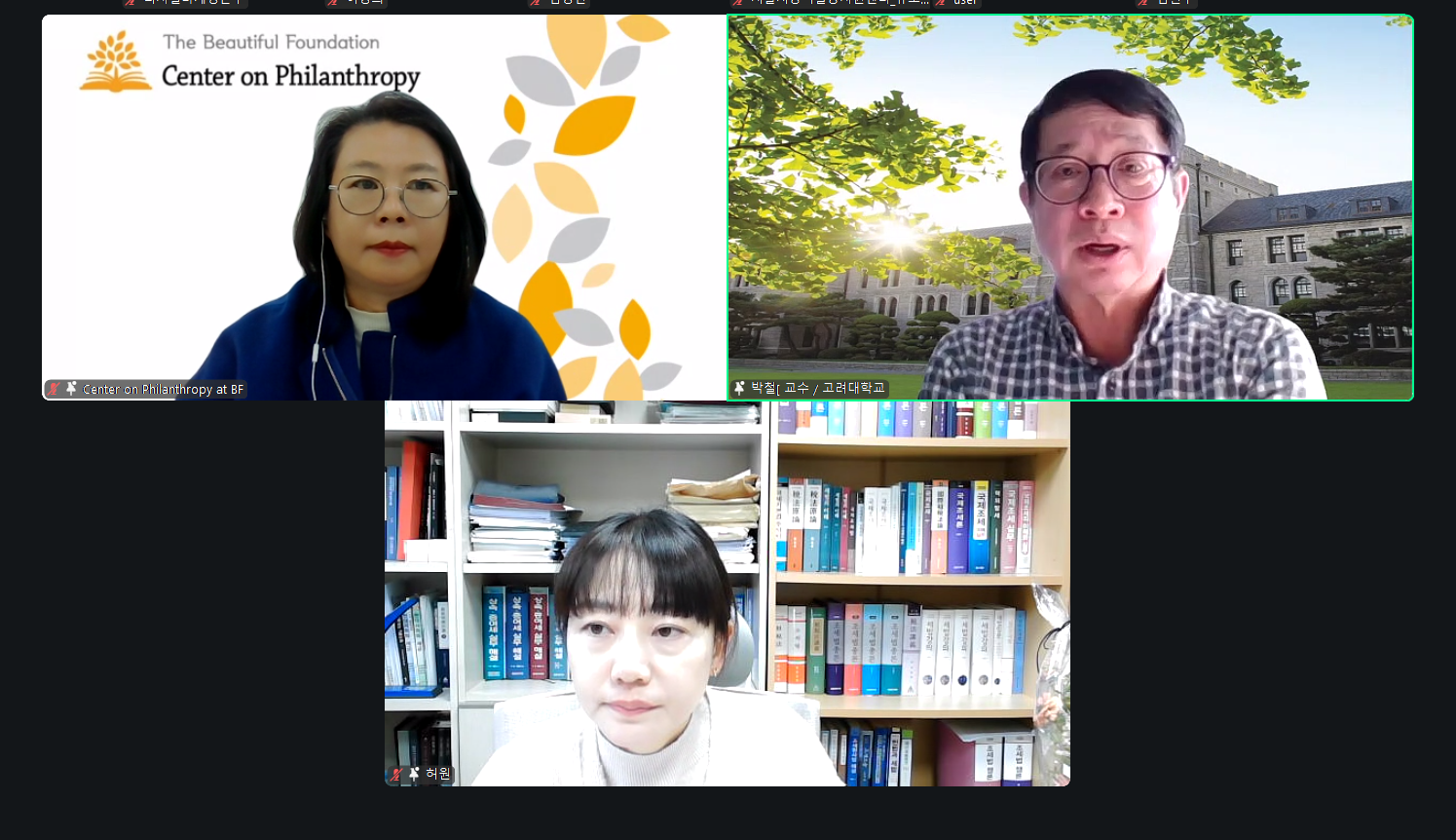
Session 1. Jin-Kyung JUNG, Cheol PARK, Won HUR
3. A Study on the Giving Activities of Migrants – Focusing on Volunteering and Giving (Min-young LEE , Professor at Department of Social Welfare, The Cyber University of Korea)
This qualitative study explores how volunteering and giving by migrants in Korea affect their identity, social integration, and psychological well-being.
• Core Themes: The research identified four key themes: “Identity Shift: From Receiver to Donor,” “Restorative Healing: Self-recovery as a Caregiver,” “Arena of Social Integration: Moving Beyond Adaptation,” and “Transnational Practice: Connecting Borders and Generations”.
• Conclusion: Migrant giving is a complex practice that combines existential recovery with social integration, suggesting a new form of citizenship in a multicultural society.
Q&A Highlights:
• Global Context: In Germany, about 13% of refugees participate in volunteering, and this increases to 40% with longer stays. In Turkey, companies often emphasize social responsibility by hiring Syrian refugees. In Greece, migrants play practical roles as “connectors” or translators despite economic hardships.
• Influencing Factors: The length of residence and legal status stability (particularly for refugees) significantly impact participation. While economic status matters, those with fewer resources often participate through volunteering or advocacy rather than monetary donations.
4. Do Eco-friendly Materials Strengthen Pro-social Behavior? – Fundraising Effects of Plastic vs. Wood Donation Boxes (Sujin SONG, Professor at College of Global Business, Korea University and Song Chae-won, Ph.D. Candidate at Korea University)
This research explores whether exposure to eco-friendly materials (like wood vs. plastic) influences non-consumption pro-social activities such as donating or volunteering.
• Findings: Exposure to eco-friendly materials significantly increased pro-social behavior. Physical and environmental stimuli can activate moral emotions and induce behavioral changes.
Q&A Highlights:
• Authenticity and Consistency: While eco-friendly elements are effective, they must be used carefully. If an organization claims to value the environment but acts inconsistently, it faces immediate negative evaluation and “punishment” from the public due to a perceived lack of authenticity.
• Internal Trust: Employees are more likely to participate in CSR when they trust the organization, highlighting the link between authentic messaging and internal engagement.
5. Exploring Key Predictors of Donation Using Machine Learning (Young-joo LEE, Researcher at Educational Research Institute, Yonsei University)
Using machine learning on the 2022 Giving Korea data, this study predicted individual donation behavior.
• Key Predictors: Unlike previous studies focusing on demographics (income, age, religion), this model found that “Agreement with Nonprofit Organizations” and “Intention for Social Participation” were the most significant factors.
• Conclusion: To increase donations, organizations must ensure transparency in their accounting and consistently share the outcomes of their projects to build long-term trust with donors.
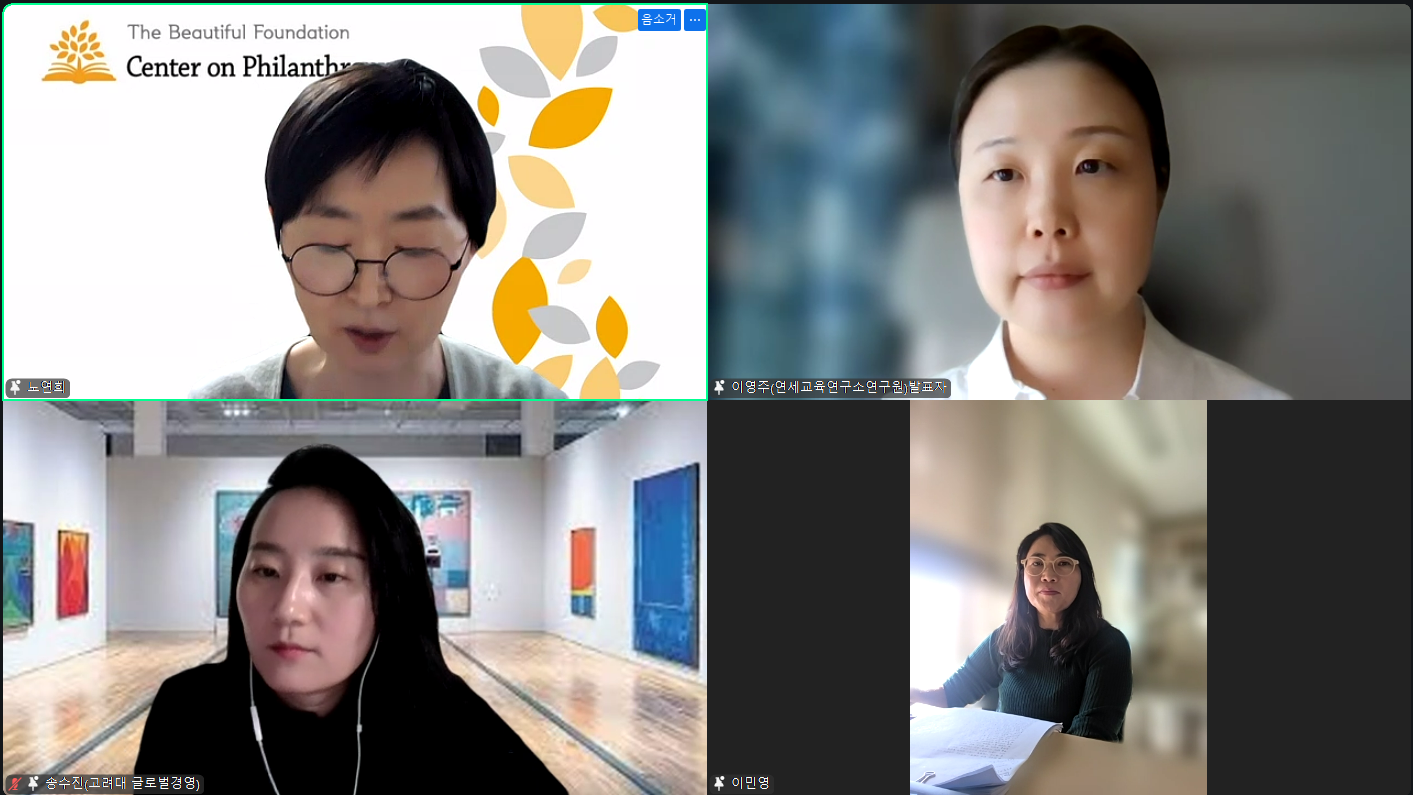
Session 2. Yeon Hee RHO, Young-Joo LEE, Sujin SONG, Min-Young LEE
Thanks a lot for your vision to help poor women in the World
Pastor Tsala Beatrice
president of Rural and Engaged WPEN