For nonprofit foundations unfamiliar with international exchange, the story of the Center on Philanthropy at The Beautiful Foundation‘s global network offers useful hints. Since 2001, the Center has hosted the “Giving Korea” symposium as an international event to broaden the context of Korean philanthropy and create synergy by growing alongside other nations.
History of the International Network
In 2006, the Center began attending ARNOVA (Association for Research on Nonprofit Organizations and Voluntary Action), a world-renowned academic society. Networking with global institutions such as WINGS (Worldwide Initiatives for Grantmaker Support), IFC (International Fundraising Congress), and COF (Council of Foundations) followed, evolving into the current international network. Exchanging with overseas organizations provided a valuable opportunity to find answers to the limitations of domestic research and established a foundation for viewing Korean philanthropy through a lens connected to global civil society.
Cooperation with International Research Institutions: CAPS, IU Lily Family School of Philanthropy, and Academic Societies
Currently, the Center on Philanthropy at The Beautiful Foundation maintains steady exchanges with the CAPS (Centre for Asian Philanthropy and Society) and the IU (Indiana University) Lilly Family School of Philanthropy.
• CAPS researches and disseminates best practices, models, and policies for philanthropy in Asia.
• IU Lilly Family School of Philanthropy is the world’s first college dedicated to the professional study and research of philanthropy.
The Center also introduces trends in Korean philanthropy and learns global trends by participating in international conferences like ARNOVA or ISTR-ASIA PACIFIC. When presenting “Giving Korea” (the Center’s philanthropy index), international researchers often express great interest in the trends and organizational standards of the Korean nonprofit sector. Furthermore, through DGI (Doing Good Index) in collaboration with CAPS since 2016, the Center discusses common challenges and research methods with partners from 17 Asian countries.
The Center also collaborates with the IU Lilly Family School on the GPEI (Global Philanthropy Environment Index). As the Korean partner, the Center provides data on the domestic giving environment, which serves as a crucial opportunity to identify Korea’s strengths and challenges in a global comparison.
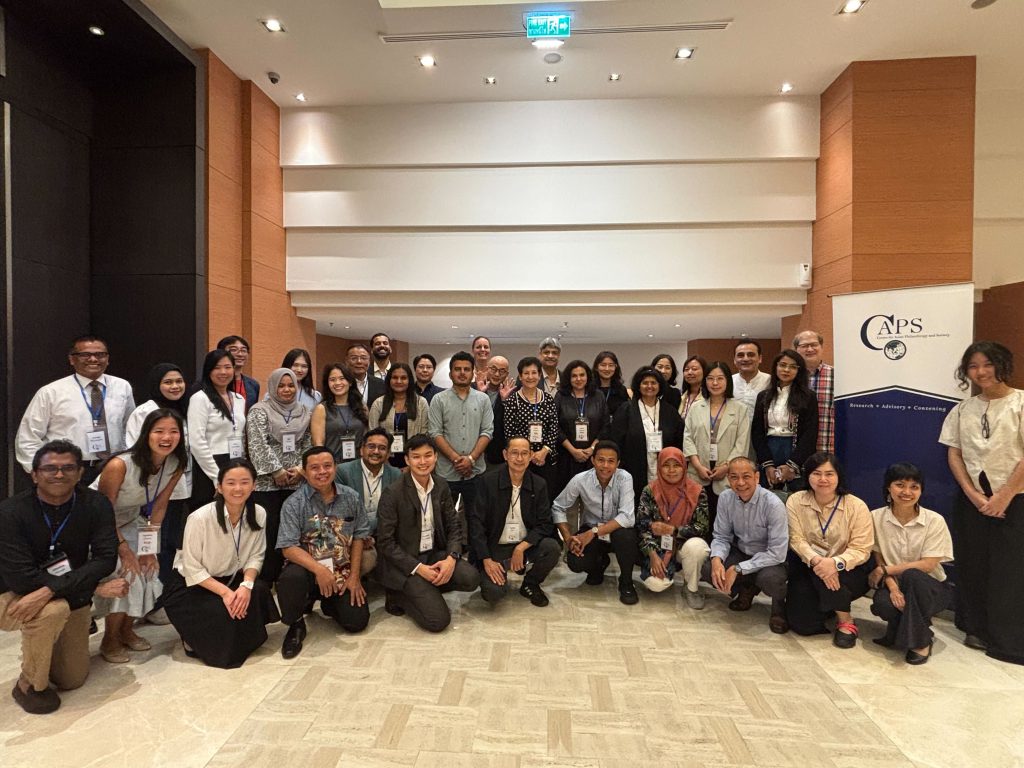
A group photo during DGI workshop in Bangkok (Source: CAPS)
New Perspectives Gained Through Exchange
International networking has provided opportunities to view routine topics from new perspectives. By introducing Korean cases, the Center has rediscovered its own values and characteristics. Recently, the Center contributed an article on digital-based philanthropy in Korea to NPO CROSS, an opinion site for Japanese nonprofit professionals operated by JNPO (Japan NPO Center). Additionally, through the ISTR-ASIA PACIFIC newsletter, the Center shared insights on the digital transformation of the Korean nonprofit sector, allowing the world to understand the current state of Korea’s civil society.
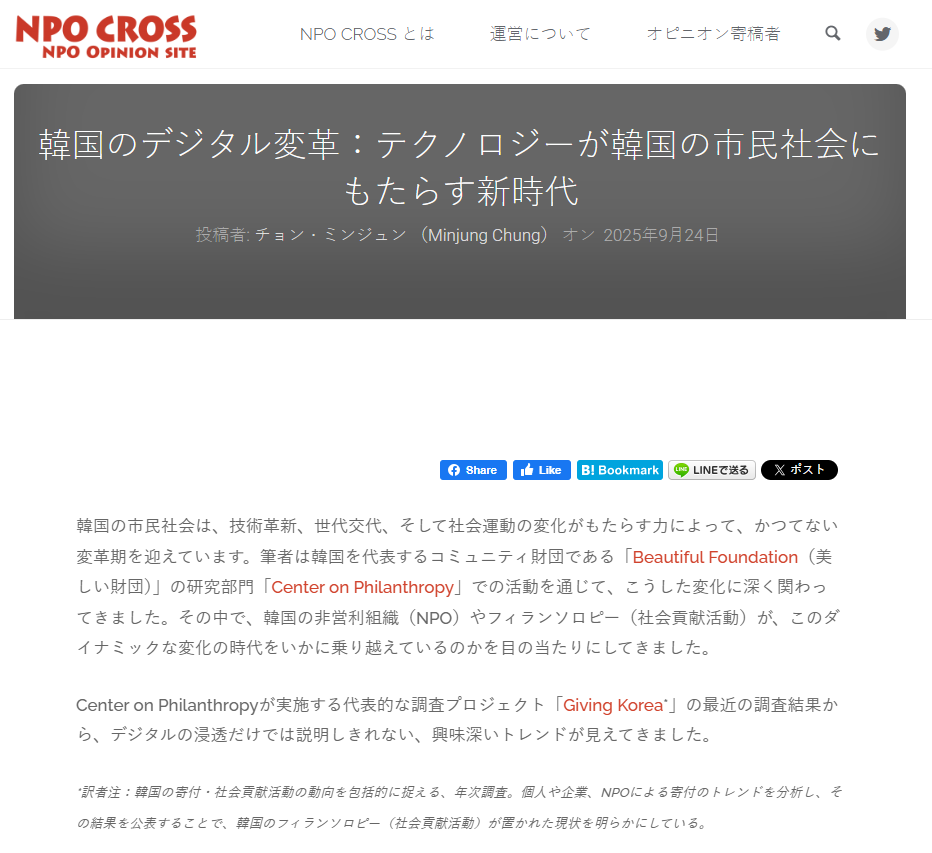
Source: NPO CROSS
The Future of the Center on Philanthropy through International Networks
The Center’s international network will serve as a vital foundation for exploring philanthropy with greater depth and breadth. Looking back, these networks were not always formed through special events. In many cases, overseas institutions first showed interest because the Center consistently published information about Korean philanthropy in English. For instance, CAPS sought out the Center as a partner due to this continuous exposure of content.
The Center plans to continue strengthening links with domestic and international researchers, sharing Korean philanthropy data more widely, and expanding joint research with Asian civil society. These efforts will accurately highlight the trends of Korean philanthropy and play a key role in gaining new insights through mutual global exchange.