As the foundation for activities and resource linkage in the non-profit sector, two major tasks are currently under intense discussion for full-scale implementation: the enactment of the Framework Act on Civic Participation and the expansion of the Hometown Love Donation Scheme. How should civil society interpret these shifting tides, and what preparations are necessary?
The Ministry of the Interior and Safety has designated the enactment of the Framework Act on Civic Participation as a priority task. The draft includes provisions to establish a dedicated body to oversee, coordinate, and support participation policies, the creation of a (tentative) National Civic Participation Committee, and the formulation of master plans to provide a legal and institutional foundation. This moves toward systematically organizing and linking participation policies that were previously fragmented across various ministries.
Meanwhile, the Hometown Love Donation Scheme, now in its fourth year, is undergoing review for expansion in 2026. Proposed directions include introducing corporate donations, easing residential restrictions, and increasing the autonomy of private platform operations to revitalize participation. These improvements aim to secure regional finances and support the resolution of local issues.
The Intent and Key Issues of the Framework Act on Civic Participation
The Framework Act on Civic Participation is a legislative measure designed to regulate matters concerning direct participation, the expansion of deliberative public forums, the promotion of democratic civic education, and the revitalization of civil society. The bill defines key concepts such as civic participation, policy participation, public interest activities, and civil society organizations. This reflects a move to expand civic involvement across the entire policy process and to institutionally recognize and strengthen the role of civil society.

Source: Pixabay
However, during the enactment discussions, questions have been raised regarding the practical effectiveness of the legislative design. At a forum held on January 19, 2026, participants discussed how “participation” as a right would be guaranteed and operated within legislative and administrative processes. For instance, questions arose as to whether the right to participate could be interpreted as an obligation imposed by the National Assembly or administrative agencies under this bill, and whether such a structure is realistically feasible.
Furthermore, regarding the lack of a primary oversight ministry—a long-standing structural limit of the non-profit sector—the need was also raised to review whether the bill accounts for conflicts and overlaps between regulatory domains that currently constrain civic activities. Thus, while the intent of the Framework Act is clear, diverse opinions persist regarding the challenges of its design and execution.
Trends and Controversies in Expanding the Hometown Love Donation Scheme
The Hometown Love Donation Scheme was introduced to alleviate regional imbalances and bolster local finances. While inspired by Japan’s “Hometown Tax” (Furusato Nozei), the Korean program is uniquely designed around “donations” rather than “taxes,” leading to differences in its operational nature.
Despite early challenges—such as platform stabilization, limitations on thank-you gifts, and disparities between municipalities—the total donation amount continues to climb. According to data from the Ministry of the Interior and Safety, donations rose from 65.1 billion KRW in 2023 to 87.9 billion KRW in 2024, reaching 151.5 billion KRW in 2025. This upward trend suggests the scheme is effectively facilitating a flow of capital toward non-metropolitan local governments.
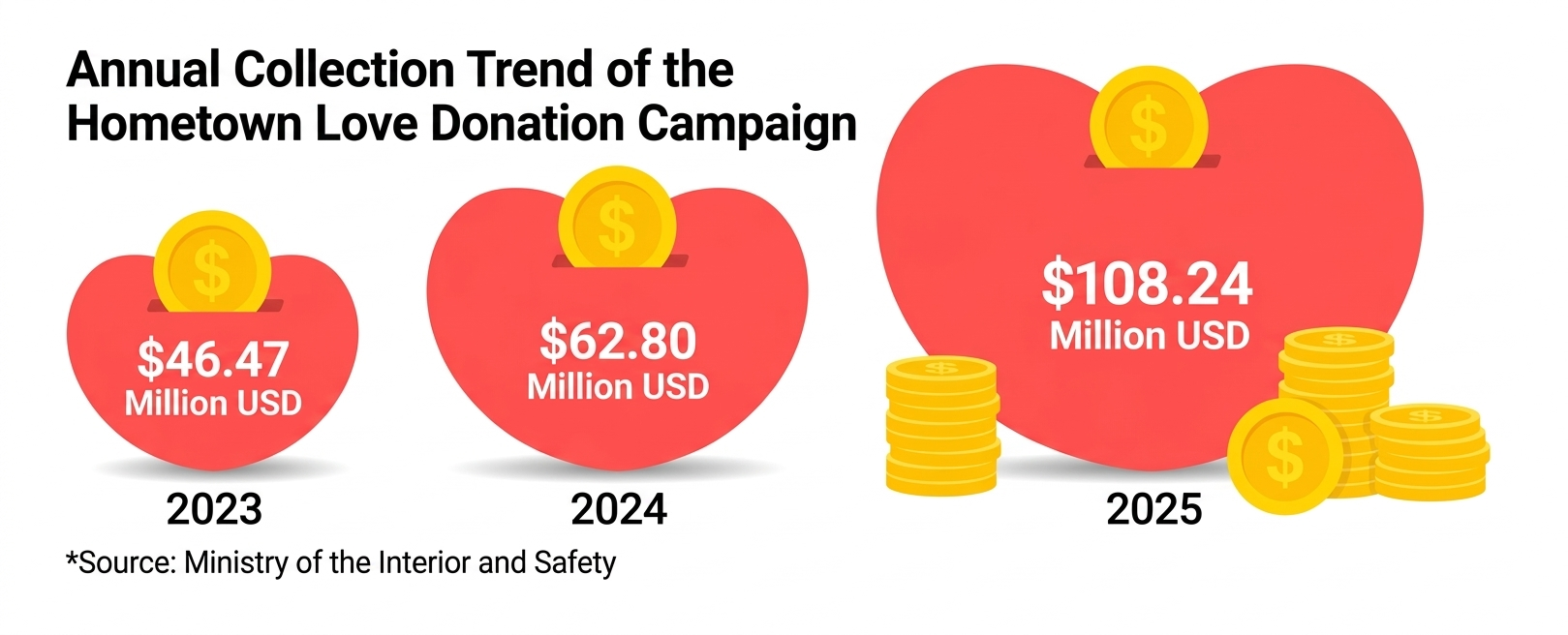
While currently limited to individuals, the introduction of corporate donations (targeted for 2026) requires a cautious approach. The Act on Collection and Use of Donated Contributions was originally enacted in the 1950s to prevent the practice of government or local authorities coercing individuals and corporations into giving. The current exclusion of corporations from the Hometown Love Donation Scheme is rooted in this history; allowing corporate donations could inadvertently act as a “quasi-tax” burden on businesses. Furthermore, accountability in distribution is just as vital as the scale of collection.
Legal and Institutional Changes in Participation and Giving
Legal and institutional changes governing participation and giving can either constrain or expand the role of civil society. What matters most is the process of creating these frameworks and how they function on the ground. When civil society acts not as a passive subject of institutional change but as an active agent of interpretation and discussion, these frameworks can become a powerful foundation for public interest activities and generate synergy. The accumulation and sharing of these discussions will serve as the essential bedrock for the future environment of civil society.