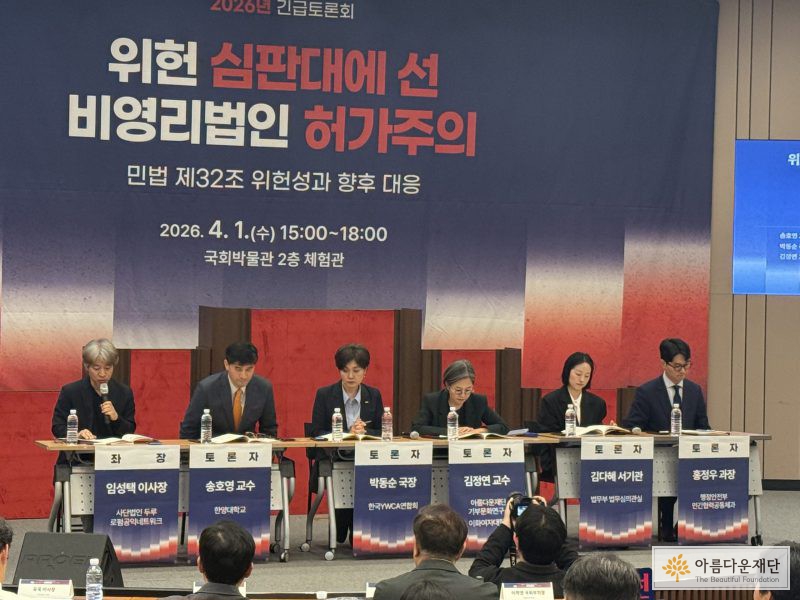
The urgent forum “The Permission System for Nonprofit Corporation on Trial for Unconstitutionality,” held at the National Assembly Museum on April 1st, 2026, offered an in-depth examination of the legal and practical limitations of the current Article 32 of the Civil Act, drawing on presentations by experts from various fields as well as empirical data. Article 32 of the current Civil Act provides that “an association or foundation whose purpose is academic, religious, charitable, artistic, social, or otherwise non-profit-making may be established as a corporation with the permission of the competent authority.” Where such permission is not granted, applicants may be forced to abandon incorporation altogether or to wait for extended periods. Prompted by the Seoul Administrative Court’s referral for a constitutional review (2025-A-12945), the forum accordingly examined how the anachronistic “permission system” is constraining the autonomy of civil society.
The Unconstitutionality of the Permission System and International Trends
The first presenter, attorney Kim Gyeong-mok of Bae, Kim & Lee LLC, argued that Article 32 of the Civil Act violates the constitutional principle of parliamentary reservation* because it fails to set out specific permission requirements in statute and instead leaves them to the broad discretion of administrative agencies. He emphasized, with supporting data, that while for-profit corporations are established under a normative (rule-based) system that requires only the fulfillment of statutory conditions, subjecting nonprofit corporations alone to prior control under the label of “permission” raises serious concerns about a violation of the principle of equality.
*Principle of parliamentary reservation: the constitutional principle that essential matters concerning the rights and duties of citizens must be regulated directly by the legislature through statute, rather than delegated to subordinate legislation.
Imbalance in the Corporate Establishment System (based on 2023 corporate tax filings)
| Category | Share of all corporations | Method of establishment |
|---|---|---|
| For-profit corporations | 95.9% | Normative system (registration upon meeting requirements) |
| Nonprofit corporations | 4.1% | Permission system (broad administrative discretion) |
Professor Lee Dong-jin of Seoul National University School of Law analyzed the state’s mode of involvement in the establishment of nonprofit corporations from an international perspective. He pointed out that major advanced countries such as Germany (following its 2002 amendment) and Japan (following the enforcement of its General Incorporated Associations Act in 2008) have already shifted to a normative or authorization system that excludes discretion, and that among OECD countries, virtually none, apart from Korea, maintains a permission system granting such broad discretion. “A permission system still rooted in a nineteenth-century notion of state charter is out of step with the mature civil-society capacity of twenty-first-century Korea,” he said, stressing the need for systematic legal reform.
“Elastic Standards” and Administrative Barriers Experienced on the Ground
Kim Deok-san, chairman of the Korea Association of Public Interest Corporations, who presented actual field cases, addressed the arbitrary disposition by the Ministry of Gender Equality and Family during the establishment-permission process for “Youth Direct Action.” The practice whereby a competent authority rejects applications by demanding requirements not found even in its own internal guidelines—such as a “minimum basic-asset threshold” or “securing offices nationwide”—was interpreted as functioning, in effect, as a mechanism of prior censorship. Indeed, a request for information disclosure revealed that administrative inconsistency had reached an extreme: within the very same ministry, some corporations were established with no basic assets at all, while others were rejected on grounds of “financial stability” despite having pledged tens of millions of won in contributions.
Voices from Academia and the Field
Professor Song Ho-young of Hanyang University School of Law criticized the courts for having misconstrued Article 31 of the Civil Act as “a provision that denies the free establishment of corporations.” He noted that the Civil Act bars the front door (establishment permission) while leaving the back door (such as standing to sue in litigation) open, thereby producing numerous unincorporated associations and undermining the safety of transactions.
Park Dong-sun, a director of the National YWCA of Korea, shared the confusion encountered in the process of incorporating the Korean YWCA’s fifty regional organizations. By describing how the required scale of basic assets and the contents of the articles of incorporation varied enormously from one local government or ministry to another—even though the organizations were identical and all were incorporated associations—she demonstrated the inconsistency of the administration.
The Non-normative Nature of the Permission System, Seen Through Empirical Research
Finally, Professor Jung Yeun KIM, a research fellow at Center on Philanthropy at The Beautiful Foundation, drew on empirical findings to highlight the problem of the boundless expansion of the concept of “competent authority.” She noted that independent bodies such as the National Election Commission and the Board of Audit and Inspection, as well as the National Assembly Secretariat, all exercise permission authority—an extraordinarily broad system without parallel anywhere in the world—thereby shifting excessive costs onto applicants. She also pointed out that, because the requirements for establishment rest on opaque internal guidelines rather than on statute, predictability is severely lacking.
The forum reached a shared understanding that nonprofit corporations should be redefined not as objects of state control but as partners in social innovation. Korea currently exhibits a distorted structure in which for-profit corporations, whose social influence is greater, are left open under the normative system, while the growth of nonprofit corporations is blocked by a permission regime.
With a decision by the Constitutional Court now imminent, it is time to break free from the framework of a seventy-year-old Civil Act, shift the establishment of nonprofit corporations to a normative system, and fully guarantee freedom of association. Transparency and accountability are best secured not through barriers at the establishment stage but through a rigorous system of post-establishment oversight—an approach that accords with the constitutional spirit of a democratic state governed by the rule of law.