In April 2026, the Center on Philanthropy at The Beautiful Foundation released the findings of The Current State of Generative AI Use Among Nonprofit Workers in Korea, a study based on a survey of 302 nonprofit workers. The researcher who led the study observed that while individuals are already using AI, their organizations have not kept pace—and that even within a single nonprofit, patterns of AI use take several distinct forms depending on people’s awareness and attitudes and on organizational conditions.
One finding stayed longer than any other, yet the researcher did not get the chance to share it at the seminar: whether a person’s level of AI use was high or low, there is no statistically significant difference in their sense that “my work matters to society”—their sense of meaning in the work itself.
This result can be read in two ways. On one hand, it may mean that nonprofit workers do not experience AI as a threat to the value of their work. Using AI did not lower their sense of the social meaning of that work. This suggests that, at least for now, AI is being received in the nonprofit field less as a technology that undermines the mission and more as a relatively neutral tool that supports the work. On the other hand, it may mean that AI is reaching as far as improving efficiency, but is not yet sufficiently connected to expanding an organization’s mission or impact. If so, what should we do? There is an article, and a set of questions, worth thinking through together:
“A Path Through AI Overwhelm,” published in the Stanford Social Innovation Review (SSIR), proposes that the first question a social-impact organization should ask when discussing AI strategy is: “AI for what?” Conversations about adopting AI tend to begin with which tool to use, but before that, an organization must be clear about the problem it is trying to solve and the purpose of using AI. AI is not a question of technology but of strategy— furthermore, a question that prompts an organization to re-examine its mission and responsibility.
The article frames this along a spectrum running from productivity to transformation. At one end sit uses that improve internal efficiency—drafting communications, summarizing meeting results, automating workflows. As our domestic survey also showed, this is often the first possibility of AI that nonprofits experience firsthand. At the other end are uses that reach more people faster and more effectively, or open up resources and systems that were once out of reach. Here, AI moves beyond a simple work aid to become a means of expanding the organization’s mission.
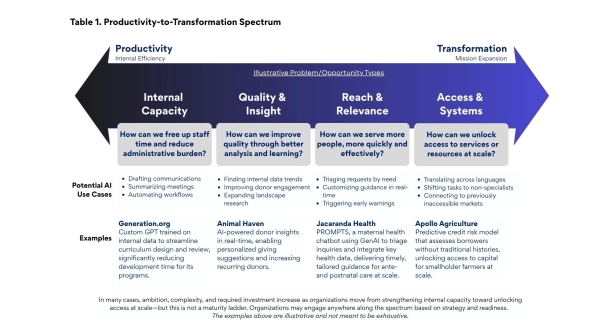
Source: Stanford Social Innovation Review (SSIR) article “A Path Through AI Overwhelm,”
The article stresses that this spectrum does not mean every organization must move straight to the “transformation” stage, nor that progress must be linear. (The survey likewise classified respondents into four types based on individual awareness / attitudes / organizational conditions, while emphasizing that these are not stages that evolve one into the next.) Rather, the spectrum helps each organization examine where it currently stands, what problem it is trying to solve, and how much preparation and responsibility are required. AI that reduces the burden of internal administration and AI that delivers information directly to underserved communities may rely on the same technology, but they demand different levels of responsibility. The data required, the verification processes, the privacy standards, and the way people stay in the loop must all differ accordingly.
To use AI strategically, then, a nonprofit needs to sit with—and answer—the following questions.
The first question is: What are we using AI for? We should ask which of the organization’s problems the use of AI actually addresses—whether it simply reduces working hours, or whether it serves more people with better services. Without a clear connection to the mission, AI may be a convenient tool, but it will struggle to become a strategic asset.
The second question is: What do we need in order to do this well? Using AI well takes more than individual interest and capability. It also requires data management, privacy protection, internal guidelines, staff training, verification processes, and clear lines of accountability. One point from the survey is especially important: concerns about security risks and capability gaps appeared regardless of an individual’s level of AI use. In other words, using AI more does not automatically resolve worries about security or gaps. The next task in AI adoption lies not only in shifting individual attitudes, but in the institutional readiness of the organization.
The third question is: How do we hold expectations and concerns together? In the survey, positive attitudes toward AI were positively correlated with level of use. The more people felt that AI improves efficiency, complements expertise, and enables new ways of working, the more they tended to use it. Concerns about the erosion of expertise and conflicts with public-interest values, by contrast, were negatively correlated with level of use. This shows that AI is not merely a matter of technology adoption; it bounds up with the identity of nonprofit work itself.
In nonprofits, concern is not the simple resistance. It arises from values—public interest, accountability, and trust. An organization should therefore neither speak of AI in purely optimistic terms nor dwell only on its risks. As the SSIR article notes, what is needed is a leadership that holds both possibility and limitation together, navigating between inflated optimism and extreme alarm.
The fourth question is: What is the right pace for our organization? The corporate conversation around AI emphasizes faster adoption and more automation. But nonprofits operate under different conditions. Inaccurate information, biased judgments, and inappropriate automation can go beyond ordinary work errors to harm people and communities. For nonprofits, faster is not always better. SSIR argues that social-impact organizations should move at the “speed of trust.” Caution is not falling behind; it can be the fitting choice—and the sound strategy—for upholding public responsibility.
AI cannot stand in for the purpose of a nonprofit. But it can be an occasion for a nonprofit to ask its purpose more clearly, to re-examine how it works, and to set fresh standards for trust and accountability. What matters is not using AI more, but using it in a way that is true to the nonprofit mission.
In the end, the next stage of AI use in nonprofits lies in moving beyond efficiency toward the question of mission. Whether AI remains a tool that merely lightens the workload, becomes a means of creating better change for more people, or is even something whose overheated adoption should be paused for a moment—all of this depends on the questions an organization asks and the standards it sets.
For a full report in Korean: https://research.beautifulfund.org/24311/
Written by: Hyomi Ahn
Translated by: Minjung Chung